On September 9, the Center for Drug Evaluation (CDE) of NMPA released 61 frequently asked questions (FAQs), covering drug R&D, registration, variations and other regulatory segments.
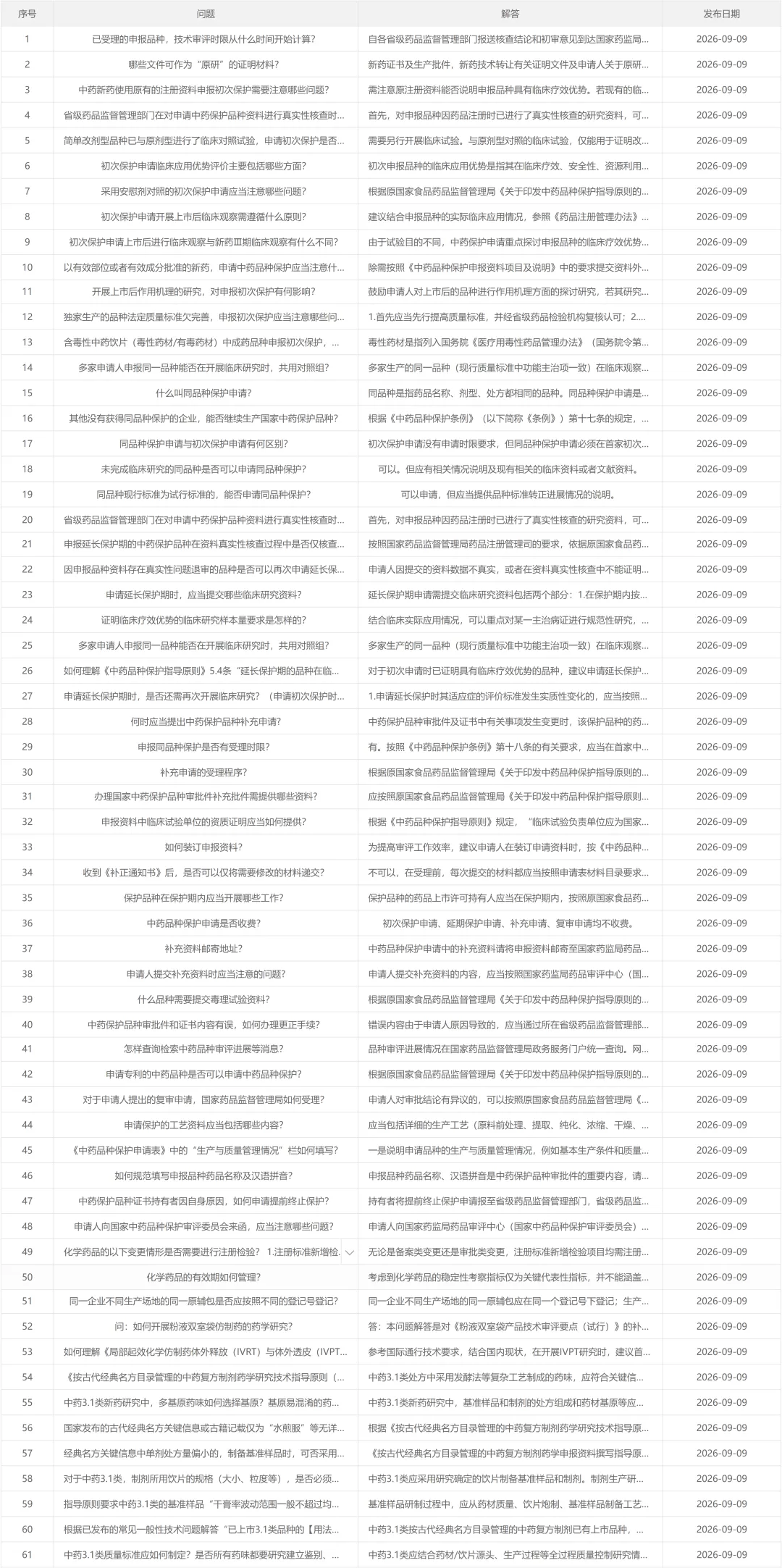
We have sorted out 41 TCM-related FAQs as follows:
What points should be noted when a new TCM drug uses original registration data for the first application for TCM variety protection?
It shall be verified whether the original registration data can demonstrate the clinical therapeutic advantage of the candidate variety. If the available clinical trial data are basically complete and compliant and only prove safety and efficacy, supplementary data are required to support its clinical advantage. The sample size shall meet statistical requirements to scientifically demonstrate therapeutic superiority. Applicants may conduct an additional clinical observation with 100 paired cases. For multi-indication varieties, one primary indication can be selected for observation according to clinical practice; if multiple indications are studied, no less than 60 pairs shall be included for each indication to verify therapeutic advantages.
What shall provincial drug regulatory authorities note when verifying the authenticity of data submitted for TCM variety protection?
First, study data that have undergone authenticity verification during drug registration may be exempted from repeated verification. Second, for data requiring verification, inspections of trial sites shall be completed within the specified time limit. If it is impossible to inspect all clinical sites on schedule, at minimum the lead site and one participating clinical site shall be inspected, with clear inspection conclusions. [Guo Shi Yao Jian Zhu〔2009〕No.57, Article 3]: After receiving the application dossier and acceptance notice, provincial drug regulators shall complete authenticity verification and preliminary review within 20 days, and forward the inspection report, preliminary opinion and one copy of the application dossier to CDE (National TCM Variety Protection Review Committee). CDE initiates technical review upon receipt of these materials.
What shall be noted for first protection applications adopting a placebo control?
Per Guo Shi Yao Jian Zhu〔2009〕No.57, positive drug control is generally required for clinical trials; placebo control may be adopted when necessary. Key requirements for placebo-controlled trials:
What is the difference between post-marketing clinical observation for TCM protection applications and Phase III clinical trials for new drugs?
Due to different trial objectives, TCM protection applications focus on demonstrating clinical advantages and characteristics. Comparator selection principles:
---For comparable TCM products as controls, the indications and functions shall be consistent with the test drug (per official standards or package insert). If an exact match is unavailable, products with identical treated disease and similar functions may be selected.----When chemical drugs are used as controls, comparison on major symptom improvement is required in addition to disease outcome evaluation.
----For combined TCM and Western medicine regimens, trials shall focus on demonstrating significant synergistic efficacy or reduced toxicity.
What shall be noted for new drugs approved based on effective fractions or active ingredients applying for TCM variety protection?
Apart from documents specified in the Document List and Instructions for TCM Variety Protection Applications, supporting data on mechanism of action, pharmacokinetics, dose-effect or dose-toxicity relationships are recommended to illustrate the clinical advantages of the product.
What quality control considerations apply to proprietary Chinese medicines containing toxic TCM raw materials for first protection application?
Toxic medicinal materials refer to the 28 toxic substances listed in the Measures for the Administration of Medicinal Toxic Drugs (State Council Decree No.23). Toxic/toxicity-marked materials are those labelled as highly toxic or toxic in the current edition of Chinese Pharmacopoeia and other statutory standards. For such varieties, limits for toxic constituents shall be established in the quality standard. Uniformity testing shall be included for oral solid dosage forms. For constituents that are both toxic and pharmacologically active, both upper and lower limits shall be controlled (per Chinese Pharmacopoeia). Toxicity of different valence states of heavy metals shall be considered to set proper limits. To guarantee batch-to-batch consistency, applicants are advised to provide process validation reports demonstrating uniform content of toxic components.
What is an application for same-variety protection?
Same varieties share identical drug name, dosage form and prescription. A same-variety protection application is submitted by other manufacturers of the same product after the first applicant’s first protection is approved and publicly announced, in accordance with Article 18 of the Regulations on the Protection of Traditional Chinese Medicine Varieties. [Article 18]: Where an approved protected TCM variety was produced by multiple enterprises before approval, manufacturers that have not obtained the Protection Certificate shall submit applications within six months from the announcement date. NMPA-designated laboratories conduct quality testing. NMPA may: (1) issue a supplementary Protection Certificate for varieties meeting national standards; (2) revoke the drug approval number for varieties failing standards per relevant laws.
Can manufacturers without same-variety protection approval continue producing a protected TCM variety?
Per Article 17 of the Regulations, only certificate holders are permitted to produce the protected variety during the protection term. Unauthorized continuous production will trigger suspension of the drug approval number and penalties under Article 23. Enterprises with an accepted same-variety application may continue production and sales pending review and approval. [Article 17]: Protected TCM varieties shall be manufactured only by certificate holders during the protection period, except as provided in Article 19. [Article 19]: For urgently needed protected TCM varieties, NMPA may grant approval for generic production. The generic manufacturer shall pay reasonable royalties agreed with the certificate holder; disputes are adjudicated by NMPA. [Article 23]: Unauthorized generic production is treated as production of counterfeit drugs by local drug regulators. Forging certificates leads to confiscation of drugs and illegal gains plus fines up to three times the genuine retail price; criminal liability applies where offences constitute crimes.
What shall provincial drug regulatory authorities note when verifying the authenticity of data submitted for TCM variety protection?
A9. Same as Q2.
For applications to extend the protection term of a protected TCM variety, is only the lead clinical site verified during authenticity inspection?
Per requirements of Guo Shi Yao Jian Zhu〔2009〕No.57 Article 3: if all clinical sites cannot be inspected on schedule, at minimum the lead site and one participating clinical site shall be inspected, with clear inspection conclusions.
Can a variety rejected due to data authenticity issues reapply for protection term extension?
If an application for protection extension is rejected because the submitted data are unauthentic or authenticity cannot be verified, NMPA will no longer accept any subsequent protection application for this variety.
What clinical data shall be submitted for protection term extension?
Two categories of clinical materials are required:
---Clinical study data completed during the existing protection period as required by the Improvement Requirements attached to the original approval document.How to interpret Section 5.4 of the Guidance: varieties applying for protection extension shall show marked improvements in clinical, pharmacological-toxicological and pharmaceutical aspects compared with the status before initial protection?
For varieties that have already proven clinical advantages at first protection, applicants may carry out further studies on quality upgrading, bioassay-based quality control, clarification of pharmacological characteristics and package insert optimization to demonstrate substantial improvements for extension.
Is a new clinical trial required for protection extension if therapeutic superiority was already established in the first protection?
When shall a supplementary application for protected TCM varieties be filed?
The MAH shall submit a supplementary application when information stated in the protection approval document or certificate is changed.
Is there a deadline for same-variety protection applications?
Yes. Per Article 18 of the Regulations, applications shall be submitted to NMPA within six months after the announcement of the first protected variety.
What is the acceptance procedure for supplementary applications?
Per Guo Shi Yao Jian Zhu〔2009〕No.57, supplementary dossiers are reviewed by the provincial drug regulator and then forwarded to CDE. CDE accepts eligible applications.
What documents are required for supplementary approval documents of protected TCM varieties?
How to provide qualification certificates for clinical trial sites in the application dossier?
Per the Guidance: the lead clinical site shall be a national drug clinical trial institution matching the studied indication; participating sites shall be Grade A tertiary hospitals. For the lead site, provide online query screenshot from NMPA’s clinical trial institution database or qualification certificate. If a participating site is also a registered clinical trial institution, follow the same rule; if only a Grade A tertiary hospital, provide Grade A accreditation proof. The accreditation validity period shall cover the trial conduct time.
How to organize and bind application dossiers?
To facilitate review, applicants shall organize documents following the Guidance on Classification and Binding of TCM Variety Protection Dossiers. The full dossier may be bound with lever arch or punch folders for easy replacement during supplementation. Clear dividers labelled with catalogue serial numbers and down to level-3 headings are recommended.
What work shall be performed by the certificate holder during the protection period?
The MAH shall complete required studies specified in Guo Shi Yao Jian Zhu〔2009〕No.57 and the attached Improvement Requirements in the protection approval document.
Are there any fees for TCM variety protection applications?
No fees are charged for first protection, extension, supplementary and re-review applications.
Mailing address for supplementary materials?
Supplementary materials for TCM variety protection shall be mailed to CDE (National TCM Variety Protection Review Committee). Address: Business Management Division, CDE, No.22 Guangde Avenue, Beijing Economic and Technological Development Area Postal code: 100163
What shall applicants note when submitting supplementary data?
Supplementary materials shall strictly respond to the points listed in CDE’s Supplementary Information Notice and be submitted within the required timeline. Documents outside the scope of the notice will generally not be accepted.
Which varieties need toxicology test data?
Per Guo Shi Yao Jian Zhu〔2009〕No.57, toxicology study data are required for all TCM variety protection applications.
How to correct errors in the protection approval document or certificate?
If the error originates from the applicant, submit a supplementary application via the provincial drug authority to CDE. If caused by NMPA administrative oversight, apply directly to NMPA Administrative Service and Complaint Center. The original approval document and certificate shall be attached for both routes.
Where to track review progress of TCM variety applications?
Inquiries are available on NMPA Government Service Portal: https://zwfw.nmpa.gov.cn/web/index?sourceType=nmpa
Can a patented TCM variety apply for TCM variety protection?
Per the Guidance Section 2.3, varieties with pending patent or IP disputes shall resolve such disputes before filing for protection. Varieties free of IP conflicts may apply.
How does NMPA handle re-review applications?
Applicants disagreeing with the review conclusion may submit a re-review application with rationale to CDE within 60 days upon receiving the decision, per Section 8 of Guo Shi Yao Jian Zhu〔2009〕No.57. Re-review is limited to the originally submitted dossier. NMPA issues a conclusion within 50 days; if technical review is needed, CDE organizes review under the original timeline.
How to complete the “Production and Quality Management” section of the TCM Variety Protection Application Form?
Describe production conditions and quality management system; list major production and testing equipment including name, model and manufacturer.
How to standardize the Chinese name and Pinyin of the applied variety?
The drug name and Pinyin shall strictly follow the current statutory standard. Example: 灯盏花素滴丸 (Dengzhan Huasu Diwan).
How can a certificate holder apply for early termination of protection?
The holder submits an early termination application to the provincial drug authority. The provincial authority sends an official letter to NMPA Drug Registration Department or CDE stating the reason, together with copies of the certificate and approval document.
What are the requirements for official correspondence submitted to the National TCM Variety Protection Review Committee?
Correspondence shall be addressed correctly to “CDE (National TCM Variety Protection Review Committee)”, with contact person and phone number clearly marked. Documents intended for SAMR, NMPA headquarters or other divisions, or matters outside technical review (administrative reconsideration, certificate validity, administrative penalty, etc.) shall not be sent to this address. Please refer to the acceptance hall guidance Notice on Standardizing Submission.
For fermented raw materials such as fermented soybean (Dan Douchi) in Class 3.1 TCM formulations under the Classical Prescription List: requirements on origin, batch number, outsourcing and quality control?
Fermented ingredients in Class 3.1 prescriptions shall comply with published key information and national standards and may be purchased from qualified manufacturers. Multi-batch quality comparison across suppliers is recommended to fix the supplier and critical process parameters. Quality standards shall be improved based on quality studies, with special attention to mycotoxins and other safety indicators.
Selection of botanical origins for multi-origin raw materials in Class 3.1 new TCM drugs; studies for easily confused origins?
The botanical origins of reference samples and finished formulations shall be consistent with officially released key information. Where multiple origins are permitted in the key information, normally one origin shall be selected and fixed; if multiple origins are used, sufficient justification and fixed proportion are required. Materials with easily confused origins shall be identified by experts or qualified institutions with an identification report.
How to conduct research when the officially released key information or ancient literature only states “decocted in water” without detailed manufacturing procedure?
Following the Technical Guideline for Pharmaceutical Research of TCM Compound Preparations Managed under the Classical Prescription List, reasonable manufacturing processes shall be determined with reference to the Specifications for TCM Decoction Rooms in Medical Institutions.
Can multiple-dose decoction be adopted for reference sample preparation when the single-dose prescription in classical prescription key information is low?
The Guideline for Dossier Writing states that reference samples are generally decocted with one daily dose. If the single dose is low and comparative studies demonstrate no significant quality difference between single-dose and multi-dose decoction, multi-dose feeding is acceptable for reference sample preparation.
Must the specification (size, particle size) of decoction pieces for Class 3.1 finished products be identical to those used for reference sample research?
The decoction pieces used for reference sample development are fixed. For commercial production, pre-treatment studies may adjust particle size or dimensions as long as the finished product quality remains consistent with the reference sample.
The guideline specifies that dry extract yield fluctuation of reference samples is generally within ±10% of the mean and marker content within ±30%. Is it acceptable if some indicators exceed this range?
Researchers shall control quality variation through control of raw material origin, cultivation, harvesting, processing, decoction, filtration, concentration and drying. In principle, indicators shall meet the fluctuation limits; evaluation is case-by-case based on supporting study data.
For Class 3.1 classical prescription preparations: subsequent applicants must adopt the same dosage and administration as the first approved product. What studies are required if dose, frequency, fill volume and specifications are adjusted? Is new stability testing mandatory?
Subsequent applicants shall align the dosage and administration with the approved reference product, including dose per administration and daily frequency. If adjustment of fill volume, excipients and specifications is necessary, three batches of samples under the revised specification shall be manufactured with production records, test reports, stability data and a stability commitment. If formulation, excipients and packaging materials are unchanged and only fill volume changes, existing stability data of the original specification may serve as supporting evidence. Long-term stability testing shall continue post-launch to cover the proposed shelf life.
How to establish quality standards for Class 3.1 TCM preparations? Are identification and assay required for every ingredient?
Quality control shall be comprehensive, combining specific identification, dry extract yield, extractives, multi-marker quantitation and fingerprint/characteristic chromatograms, tailored to prescription, process and dosage form. Priority is given to markers from monarch drugs and active constituents; toxic constituents (e.g. aristolochic acid I in Asarum) shall be controlled. Multi-analyte detection in a single test method is encouraged.
With a professional and efficient service system and a comprehensive operational network, Guangzhou Evidence Based Medicine is committed to providing tailored one-stop traditional Chinese medicine research and development full industry chain service solutions for every customer, promoting traditional Chinese medicine to the world and safeguarding the health of more people.